
On October 21, the group that maintains PHP shipped an emergency fix for two serious flaws and asked everyone running a site to update straight away.1 PHP is the programming language that runs underneath most of the web, including nearly every WordPress site, so this is not a problem that stays with developers. It is the engine your website sits on. The flaws let a stranger run their own commands on your web server with no password and no account, which is about as serious as a website problem gets.
I'm writing about it here for two reasons. The website you sell security from is almost certainly built on this, and the way the flaw was found tells you where things are heading. A security firm called Wiz used the newest AI models to read PHP's code, understand a weakness that had been sitting there for more than ten years, and turn it into a working break-in. As they put it, what the AI changed was the ability to take a long-standing flaw and build a real attack from it.2 They showed it working against a current, fully updated WordPress site, because the hole was never in WordPress itself. It was in the PHP engine running beneath it.
An old flaw on a much faster clock
The part worth sitting with is the timing. This weakness was always there. What changed is that a machine can now read it and produce a working attack on the same morning the fix comes out, and researchers reported people already probing for it within hours.3 For years a known website flaw still gave you a comfortable margin, because the person who could actually use it might not come around for a long while. That margin is the thing AI has quietly taken away, and it is the reason I keep telling MSP owners that a smaller, simpler website is now a safer one.
There is a catch that trips up a lot of owners, too. Updating WordPress does not fix this one. The repair lives in the PHP engine, and that gets patched by whoever runs your hosting rather than from the WordPress dashboard you log into. If you are on a good managed host it may already be handled, and if your site is on a cheap plan or a server someone set up years ago it might be sitting with a person who does not know the job is theirs. For most businesses the honest answer to who owns that patch is a long pause, and that pause is the real problem.
Why this lands harder on an MSP
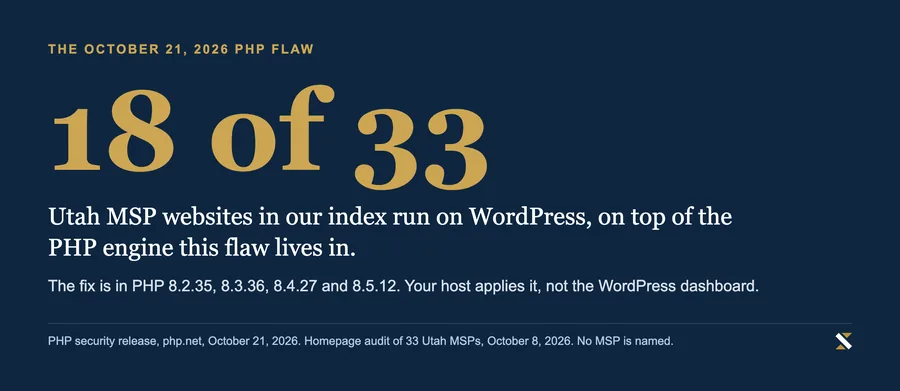
You sell security for a living, and your website is the one system of yours that every prospect looks at before they call. When we audited the sites of 33 Utah MSPs this month, 18 of them ran on WordPress.4 Most of those are a bought theme, a page builder and a stack of plugins, all sitting on the same PHP engine this flaw lives in. That is a lot of other people's code to keep patched forever, on the one page that is meant to prove you keep other people's systems safe. I wrote a longer piece on why I move MSP sites off that setup instead of patching it, and this week is a plain example of what staying costs you.
What I'd do this week
Start with your own site, and find out who patches the PHP on it. Call your host or whoever manages the site and ask one plain question, which is whether your PHP version already has this week's fix. On a WordPress site you can check the version yourself in a couple of minutes by opening Tools, then Site Health, then Info, then the Server section, and comparing it against the versions PHP published.1 If you cannot get a clear answer by the end of the day, taking the site offline for a little while is a reasonable move, and some organizations, the HR software company BambooHR among them, did exactly that this week as a precaution.3 Then ask the same question about your clients' sites, because the ones on WordPress are in the same spot, and being the person who warned them is a good place to be.
None of this means WordPress is uniquely dangerous. It means a brochure website that mostly shows pages and collects a form does not need to carry a live engine and a plugin list that someone has to guard forever. That is the whole reason we build an MSP's foundation on a setup that serves finished pages, with no plugins or PHP engine for anyone to patch on a Friday night. If you want to see where your own site stands first, the search check takes five questions and about a minute.
Not sure your site is built on the right foundation?
The free snapshot scores your website setup along with your reviews and what AI assistants say about you, and it usually arrives by email within the hour.
- PHP, security release announcements and critical advisory, php.net, October 21, 2026. The fix is in PHP 8.2.35, 8.3.36, 8.4.27 and 8.5.12.
- Wiz Research, "PHP2Shell: AI uncovers critical RCE vulnerabilities affecting 70% of the Internet", October 21, 2026.
- The Hacker News, "PHP Issues Emergency Patches for Two Critical PHP2Shell RCE Flaws as Exploit Attempts Emerge", October 21, 2026.
- MSP Search Equity homepage audit of the 33 scored local Utah MSPs in the Utah MSP Search Equity Index, platform read from each site's page source, October 8, 2026. Nine sites could not be identified and are counted as not WordPress. No MSP is named.