
In October, MIT Sloan Management Review published a study of how companies show up in AI answers.1 The authors interviewed fifteen senior marketing leaders and followed one company closely, an investment platform in New Zealand. Its website ranked well on Google and its traffic from ChatGPT was growing. When the team finally asked ChatGPT the questions their customers ask, they found answers that sounded confident and were often wrong. ChatGPT said they offered five funds when they offered seven, it got their fees wrong, and some of the wrong answers came from the company's own old help pages.
I read the study with MSP owners in mind, because the same thing is happening to you right now and you can't see it. A business owner asks ChatGPT or Google's AI who handles IT support near them. The answer names a few firms, says something about each one, and the owner never clicks through to check. As one person in the study put it, "the AI's version becomes the truth."1
Being found is not the same as being repeated
The study splits the problem in two. The first part is visibility, meaning whether an AI tool names you at all. The second is accuracy, meaning whether what it says about you is true. Good search rankings help with the first, because AI tools mostly draw on pages that already rank. They don't take care of the second. The authors say it plainly: "Without SEO, there is nothing for AI to find. Without GEO, what AI finds may no longer be true." GEO, or generative engine optimization, is just the new name for making your site easy for AI tools to read and quote correctly.
What decides that is structure. An AI tool reads your page looking for a clear claim it can lift out and repeat. If your headings say "Your Partner in Technology" instead of "Managed IT support for dental offices in Ogden," and the answer a buyer wants is buried in a slider or a tab, the tool moves on to a site that says it plainly. The study names the sites that lose this way. They are "visually polished but semantically thin," which means they look good to a person but give a machine very little it can use.
What that looks like on a typical MSP website
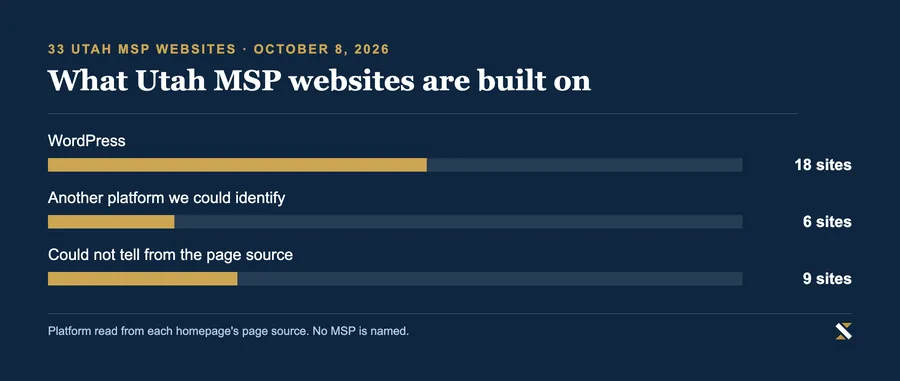
When we audited the websites of 33 Utah MSPs in October 2026, 18 of them ran on WordPress.2 Of the 24 where we could tell what the site was built on, 18 were WordPress. That matches what I've seen for years working on MSP marketing. Most of these sites are a bought theme, a page builder for laying out sections, and a stack of plugins for forms, speed, security and SEO.
That setup is built for how a page looks, not for what a page says, and that is the problem the study describes. The page builder decides how your headings are tagged based on how big they should look. Your service details end up spread across accordions and image blocks that a person can click through and a machine reads poorly. The SEO plugin adds the same generic structured data (the hidden labels that tell search and AI tools what a page is about) to every page, whether it's about co-managed IT or your holiday hours. You can fix each of these on WordPress, but every fix is one more setting, plugin or workaround layered on top of the thing that caused it.
The security problem nobody on your team wants to talk about
There is a second reason I take a hard line here, and for an MSP it matters more than for almost any other business. Patchstack, a WordPress security company, counted 11,334 new security holes in WordPress plugins and themes in 2025, 42 percent more than the year before.3 Ninety-one percent were in plugins. Almost half, 46 percent, had no fix from the plugin's developer by the time the hole was made public, and the typical time from a high-risk hole becoming public to the first attack was about five hours.
You sell security for a living. Your website is the one system of yours that every prospect looks at, and on most MSP sites it runs on a stack of other people's plugins that someone has to keep updating forever. I don't think that's a risk worth carrying for a brochure that also has to win in AI search.
Why I move sites instead of patching them
The study's biggest point is that AI tools keep repeating old pages until someone fixes the source. Keeping a site correct is ongoing work, and on WordPress most of that effort goes into keeping the site running instead of keeping it right. So when we build an MSP's foundation, we move the site off WordPress to a fast setup that serves finished pages on Cloudflare. Every word, image, address, form and brand color comes with it. Structured data, security headers and access for AI crawlers are built in from day one rather than bolted on with plugins, and there's no plugin list to patch on a Friday night.
What to check this week, even if you never call me
The study ends with a four-step routine, and you can do a small version of it yourself this week. Ask ChatGPT, Google's AI and Claude the three or four questions your buyers ask, such as who the best IT company is in your town for a business your size. Write down whether you're named and what each one says about you. Where something is wrong, click the source it cites and fix that page, whether it's yours or a directory listing. Then ask the same questions again in a month, because the answers change.
If you'd rather see where you stand first, the search check takes five questions and about a minute, and it shows your weakest area on the spot.
What does AI see when it reads your site?
The search check asks five questions and then shows you which fix to do first for your MSP.
- Shahper Richter, Alla Lvovich, Wietske Van Osch and Alex Richter, "The New Rules of Brand Visibility in AI Search", MIT Sloan Management Review, October 13, 2026.
- MSP Search Equity homepage audit of the 33 scored local Utah MSPs in the Utah MSP Search Equity Index, platform read from each site's page source, October 8, 2026. Nine sites could not be identified and are counted as not WordPress. No MSP is named.
- Patchstack, State of WordPress Security in 2026.
- The description of typical MSP WordPress setups is Danny de Vries's experience working on MSP marketing, not a survey.