
Read any set of 2026 predictions for MSPs and the security section says much the same thing. Attackers are learning to use AI agents, AI systems themselves are becoming something to protect, and clients will expect their IT provider to keep up. The chief technology officer of one of the largest US MSPs expects the first big public breach of an AI model to force companies "to treat AI as critical infrastructure rather than an experimental tool".1 I think he is right, and I think it means a lot of MSPs will spend the coming year turning up the security on their clients' websites, with stricter firewall rules, bot protection switched on and "block AI bots" boxes ticked.
That is good work. It also has a side effect nobody tends to check, which is that the switches that stop a malicious agent can also stop ChatGPT, Claude and Gemini from reading the site. And when a client's buyer asks an AI assistant which accountant, dentist or contractor to call, the assistant can only name the businesses whose sites it was allowed to read.
What I found when I checked
In late October I wrote about this for MSPs' own websites. On October 24, 2026 I asked ChatGPT, Claude and Gemini to open the homepage of each of the 33 Utah MSPs in our index and tell me the page title. All three read 32 of the 33. On the last one, Claude got a security check page every time while the other two got straight in, and the block sat in the website firewall, not in the site's own settings.2
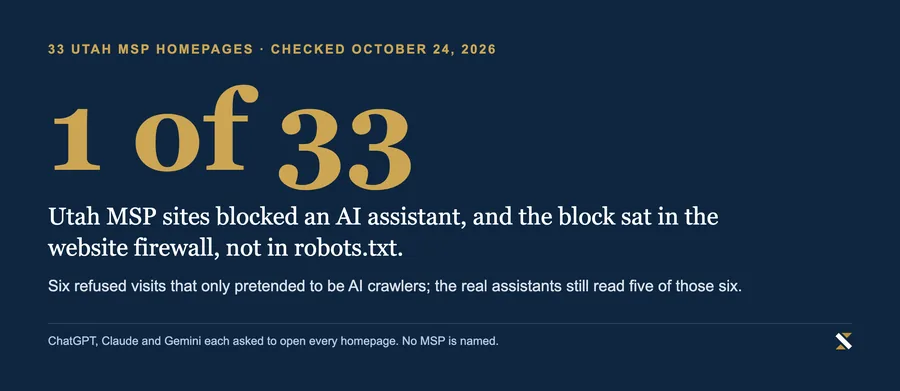
Two more things from that check matter here. Six of the 33 sites refused visits that only pretended to be AI crawlers, yet the real assistants still read five of those six, so a good firewall can tell a real assistant from a fake one. And at the one site that blocked Claude, a fake Claude visit was let in. Rules that judge a visitor by the name it gives itself get it wrong both ways.
If MSPs' own sites, run by people who know firewalls, show this pattern, I would expect client sites to show more of it, because nobody on the client's side is looking.
Where the blocks come from
I doubt the block I found was a decision anyone made about AI, and I would expect the same on client sites. Blocks like it usually come from settings made for other reasons.
- A security service in front of the site. Firewalls such as Cloudflare, Sucuri or Wordfence decide who gets a check page or a block. A stricter rule after an incident, or a setting that challenges everything that looks automated, catches the assistants along with the attackers.
- A default you clicked past. Since July 2025 Cloudflare has asked every new domain whether to block AI crawlers and blocks them by default if nobody says otherwise, so a client site moved onto Cloudflare this year may be blocking them because of a setup screen.3
- robots.txt edited by a plugin or a well-meaning developer. A broad rule telling bots to stay away, added to stop scraping, also tells the AI search visitors to stay away.
Add one check to the change
You don't need to choose between security and visibility. The setup you want stops visitors that are pretending and lets the verified assistants in, and the firewall at one site in our check did exactly that. What usually goes missing is the check afterwards. This is what I would add to the ticket whenever you change a client's firewall, bot settings, hosting or security plugins.
- Ask the three assistants to open the site. Type "Open https://clientsite.com and tell me the page title" into ChatGPT, Claude and Gemini. If any of them can't give you the right title, something in your change is in the way.
- Allow the verified AI visitors by name in the firewall, rather than relaxing the rule for everyone. OpenAI and Anthropic each publish the names their search and user visitors announce, and the firewalls that verify where a visit really comes from can let those through and keep blocking fakes.45
- Say yes in robots.txt for the AI search and user visitors (for example OAI-SearchBot, ChatGPT-User, Claude-SearchBot and Claude-User), so a later broad rule doesn't quietly undo it.
- Run the check again in the quarterly review. Firewall vendors change their defaults and plugins update themselves, so a site that was open in March can be closed by June without anyone touching it.
It is a small thing to add, and it is the kind of thing a client notices when you tell them. "We tightened your security and we checked that ChatGPT can still recommend you" is a better sentence in a quarterly review than either half on its own.
Want to see what the assistants say about your own firm?
The free snapshot checks whether AI assistants name you when a buyer asks, along with your reviews and your website setup, and it usually arrives by email within the hour.
- Dave Raffo, "MSPs Predict AI Revenue Gains, Cybersecurity Risks in 2026", MSP Summit, read October 28, 2026.
- MSP Search Equity check of the 33 scored local Utah MSPs in the Utah MSP Search Equity Index, October 24, 2026. Method in "Let the AI assistants in". No MSP is named.
- Cloudflare, "Cloudflare Just Changed How AI Crawlers Scrape the Internet-at-Large", press release, July 1, 2025.
- OpenAI, "Overview of OpenAI Crawlers", read October 24, 2026.
- Anthropic, "Does Anthropic crawl data from the web, and how can site owners block the crawler?", read October 24, 2026.