
Big companies are turning AI assistants away. Amazon blocked Meta's new shopping assistant from its store, Delta says it has no arrangement that lets an outside assistant book a flight, and Yelp only lets in assistants whose makers pay for its data.1 They have their reasons, because they sell things, and an assistant shopping for a customer can just as easily buy from someone else and skip every upsell along the way.
An MSP is in the opposite position. Nobody buys managed IT through an assistant's checkout button. They ask ChatGPT or Claude or Gemini who to call, and the firms those tools can read are the firms they can name. So the question the big retailers are wrestling with has a simple answer for you, and honestly I don't think you have a choice. You want every one of these assistants to be able to read your site, understand who you are and where you work, and hand a buyer your number.
What I found when I checked 33 Utah MSPs
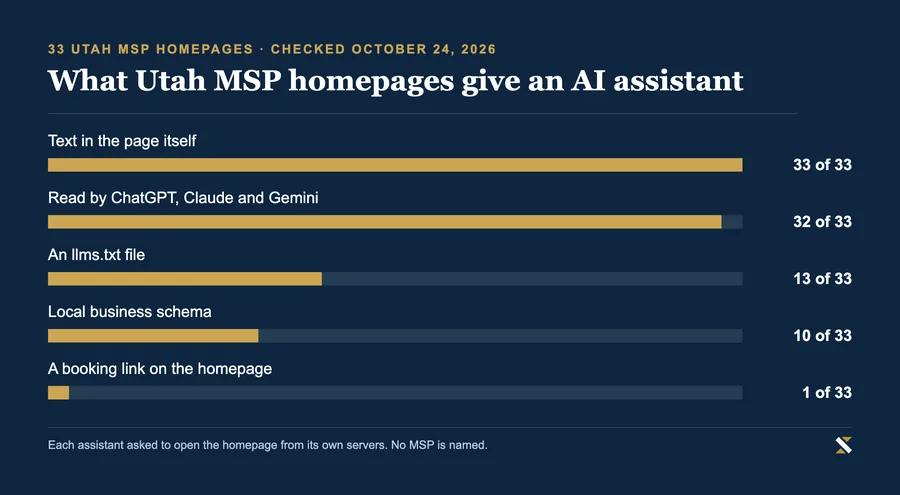
On October 24, 2026 I asked ChatGPT, Claude and Gemini to open the homepage of each of the 33 Utah MSPs in our Utah index, from their own servers, and tell me the page's title. If the title they gave back matched the real one, they had read the page. The good news is that 32 of the 33 were read by all three. On the last one, Claude got a security check page instead of the homepage every time I tried, while ChatGPT and Gemini got straight in.2 So the door is mostly open in Utah today. What I'd watch is the door closing without anyone noticing, and the fact that being let in is not the same as being easy to use, which is where most of these sites fall short.
robots.txt is the small file at the root of every website that tells crawlers what they may read, and it is where most people look when they wonder whether AI can see their site. Not one of the 33 blocks an AI assistant there. The one block I found sat in the security layer in front of the site, a website firewall that shows visitors a quick check page before it lets them through. I doubt that owner ever decided to turn Claude away. A security rule made the decision for them, and that is the pattern I'd watch for, because firewalls get tightened after a scare and nobody goes back to check what else they stopped.
One more thing surprised me. When I sent visits that only pretended to be AI crawlers, using the names the crawlers announce themselves with, six of the 33 sites refused at least one of them, mostly the crawlers that gather pages for training. The real assistants still read five of those six. At one site the firewall turned away even the faked assistant names and let the real ones straight in, which tells me it checks where a visit really comes from rather than what it calls itself. And at the one site Claude couldn't open, the faked Claude visit was let in without a fuss. So the free "is my site AI-ready" checkers, which work by pretending in exactly that way, can get the answer wrong in both directions.
The three kinds of AI visitor
It helps to know who is knocking, because the AI companies send three different kinds of visitor. The first kind gathers pages to train future models, and goes by names like GPTBot for OpenAI and ClaudeBot for Anthropic. The second kind builds the search index an assistant looks things up in, such as OpenAI's OAI-SearchBot and Anthropic's Claude-SearchBot. The third kind opens a page at the moment a buyer asks a question, such as ChatGPT-User and Claude-User, and OpenAI points out that because a person started that visit, the rules in robots.txt may not apply to it.34
Shutting out the training visitors costs you little you would notice this year. Shutting out the other two takes you out of the answer the buyer is reading right now, and Anthropic says as much about its own search and user visitors.4 My advice to an MSP is to let all three in. Your website is marketing, and the more places that have learned what you do and where you do it, the more often your name comes up.
How to let them in without lowering your guard
None of this means switching your security off. At least one site in my check runs a firewall that turns away visits pretending to be AI assistants and still lets the real ones through, which is exactly the balance you want. This is the order I work through it in.
- Say yes in robots.txt, by name. Add a group for each of the AI visitors (GPTBot, OAI-SearchBot, ChatGPT-User, ClaudeBot, Claude-SearchBot, Claude-User and PerplexityBot) with the line
Allow: /, so there is no doubt what you want even if someone later adds a broad rule for everyone else. - Check the security layer in front of the site, because that is where the blocks actually live. Since July 2025 Cloudflare has blocked AI crawlers by default for new domains unless the owner chooses otherwise, and it asks every new domain the question at sign-up, so a site moved onto Cloudflare in the last year may be blocking them because someone clicked through a setup screen.5 In Cloudflare, Sucuri, Wordfence or your host's firewall, allow the verified AI visitors and keep every other rule on.
- Make sure your words are in the page itself. Some AI readers don't run the scripts a page uses to draw itself, so a homepage that shows nothing until a script loads looks close to empty to them. All 33 Utah homepages had their text in the page, so this one is usually fine, but it is the first thing I check on a site built with a lot of scripts.
- Tell machines who you are in a form they don't have to guess at. That means local business schema, a short block of structured information in the page that gives your company name, street address, the cities you serve, phone number and hours, in the same words as your Google Business Profile. Only 10 of the 33 Utah homepages had it, and another 13 marked the company up as a general business rather than a local one, which leaves out the part that says where you work.
- Give an assistant a next step it can actually take for a buyer. A phone number written as a tap-to-call link and a plain booking link both work. A CAPTCHA on the contact form keeps spam out, and it can also stop an assistant that is filling the form in on someone's behalf, so I put a booking link next to it. Twelve of the 33 Utah homepages load a CAPTCHA service, and only one had a booking link on the homepage.
- Add an llms.txt file if you like, which is a short plain-text guide to your site written for AI tools. It is cheap and does no harm, but Google says its Search ignores it and I know of no major AI assistant that has said it relies on one, so it comes last.6 Thirteen of the 33 Utah sites have one, and three more answer that address with an ordinary web page, which tells an AI tool a file is there when it isn't.
What the setup should look like
The website I'd want for an MSP serves finished pages from a content network, the kind of service that keeps copies of your site close to every visitor, with a firewall that recognises the verified AI visitors by where they come from and lets them in while it turns away everything pretending. There is no plugin engine underneath that someone has to patch on a Friday night, which is the same reason I wrote about this week's PHP flaw. Security and access are not a trade-off in that setup, because the thing keeping attackers out is the same thing that knows which AI visitors are real. That is how we build an MSP's foundation. This site is built the same way, as finished pages with nothing underneath to patch, and all three assistants read it in the same check.
Check your own site in two minutes
You can run the same test I ran. Open ChatGPT and type "Open https://yourcompany.com and tell me the page title", using your own address, then do the same in Claude and in Gemini. If one of them can't, you have found the problem before a buyer did, and whoever manages your firewall or hosting can usually fix it the same day. Run it again after any firewall, hosting or plugin change, because that is when access tends to break without anyone noticing.
Want to know what the assistants say about you once they're in?
The free snapshot checks whether AI assistants name you when a buyer asks, along with your reviews and your website setup, and it usually arrives by email within the hour.
- Sarah Perez, "The next hurdle for AI agents: getting websites to let them in", TechCrunch, October 6, 2026. Amazon's block of Meta's Muse is reported there from Bloomberg.
- MSP Search Equity check of the 33 scored local Utah MSPs in the Utah MSP Search Equity Index, October 24, 2026. Each assistant was asked through its maker's own tools (Claude's web fetch, Gemini's URL context, ChatGPT's web search) to open the homepage and return its title, and a match with the real title counted as a read. For ChatGPT the title can come from its search results rather than a fresh visit. Sites that failed, or that refused visits using faked crawler names, were checked three times. Two control sites that allow every AI visitor were checked the same way and both came back open. No MSP is named.
- OpenAI, "Overview of OpenAI Crawlers", read October 24, 2026.
- Anthropic, "Does Anthropic crawl data from the web, and how can site owners block the crawler?", read October 24, 2026.
- Cloudflare, "Cloudflare Just Changed How AI Crawlers Scrape the Internet-at-Large", press release, July 1, 2025.
- Google Search Central, "Google's Guide to Optimizing for Generative AI Features on Google Search", last updated July 10, 2026.