
On October 30, OpenAI, Google, Microsoft and Anthropic said they will all honour one new line in a website's robots.txt file that tells AI companies not to train their models on the site.1 robots.txt is the small file at the root of every website that tells crawlers what they may read. Until now, an owner who wanted to stay out of AI training had to name each company's crawler separately, GPTBot for OpenAI, Google-Extended for Google and so on, and keep that list current as new ones appeared. The new line comes from a draft standard at the Internet Engineering Task Force, the group that writes many of the rules the internet runs on, and it was proposed by an engineer at Anthropic.2
Anthropic already honours it. Microsoft starts on February 1, 2027, Google says it will support it in 2027, and OpenAI says it will follow in the coming months. Meta says it supports the idea but hasn't said whether it will honour the line.134 If you have seen the headlines and wondered whether you should switch it on for your own site, the short answer is that this is the harmless switch, and the ones worth worrying about sit somewhere else.
Training and answering are two different things
AI companies use your website in two ways, and the new line only covers one of them. Training is when a company feeds pages into a model while it is being built, so the model learns how language works and picks up general knowledge along the way. Answering is what happens when a buyer asks ChatGPT or Copilot which IT company to call, and the assistant reads pages at that moment to put a reply together and cite its sources. Microsoft calls that second use grounding, and it is the one that gets an MSP named.
The companies are careful to keep the two apart. Microsoft says your training choice and your answering choice are independent of each other, and that neither one changes whether you appear in Bing's normal search results.3 Google says it will treat the new line as if you had blocked Google-Extended, its existing training control, and that control doesn't affect your place in Google Search.4 So saying no to training is now cheap. It won't cost you a ranking or a visit you would notice.
The settings that do cost you are the answering ones. Microsoft is adding a separate setting, page by page, that keeps a page out of AI answers, and its own announcement warns that using it will reduce your brand's visibility in AI experiences.3 Google has had a similar switch in Search Console, the free Google tool for site owners, since this summer. It takes your site out of AI Overviews and AI Mode completely, links included, so you get no traffic from them at all.5 For a business that wants buyers to find it, those are the switches to leave alone.
What I found on Utah MSP websites
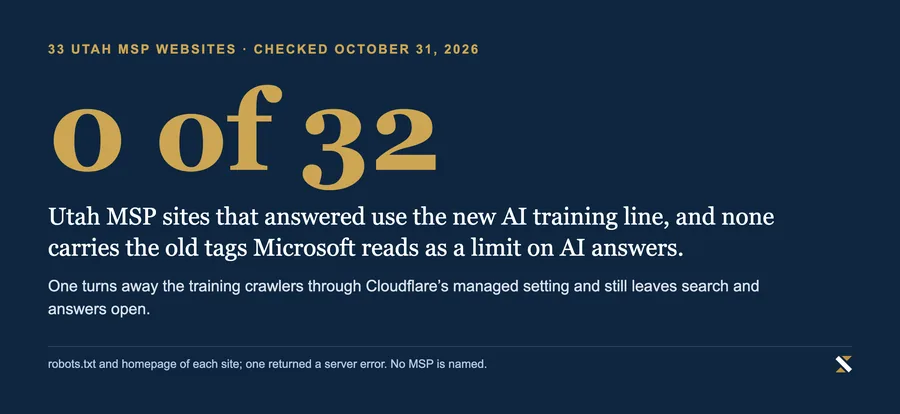
On October 31 I checked the robots.txt file and the homepage of the 33 Utah MSPs in our Utah index for every one of these signals, and 32 of them answered. None uses the new line yet, which is no surprise a day after it was announced. One site turns away the training crawlers with a robots.txt file written by Cloudflare's managed setting, which says yes to search and no to AI training and leaves the search and answer visitors alone.67 That is the safe way to do it, although I'd guess the owner ticked a box in Cloudflare rather than sat down and decided. No site blocks Bing, and none carries the old tags I describe next.
The old tags Microsoft still reads
Before this announcement, Microsoft's way of letting a site limit AI use was two short instructions in a page's code, called noarchive and nocache, which a privacy or SEO plugin will sometimes add without anyone noticing. Microsoft has read them since 2023 as a site's wish about both AI training and AI answers, and it will stop reading them that way on March 1, 2027.3 If one of your sites or a client's carries them, the owner needs to decide what they actually want before that date and publish it with the new settings. None of the Utah MSP homepages I checked carries either tag. To check your own, open your homepage, view the page source and search it for "noarchive" and "nocache".
What I'd do
- On your own site, leave both training and answers allowed. That is the default, it needs no work, and it is what I'd advise any business that wants buyers to find it. Your website is marketing, and my view is that the more AI systems have read what you do and where you do it, the more chances your name has to come up.
- If you'd still rather keep your pages out of training, the line is short. Add a group to robots.txt that reads
User-Agent: __usage_ai-trainingfollowed byDisallow: /. Keep any GPTBot or Google-Extended lines you already have, because not every company will read the new one until next year. And remember that it only asks. It does nothing about pages that were used before, and a crawler that ignores robots.txt will ignore this line too. - Don't touch the answering switches unless you really mean to disappear from AI answers. That means Microsoft's page-level setting for AI answers and the Search generative AI control in Google Search Console.
- Check the security layer as well as the file. robots.txt is where you say what you want, but the one block I found on a Utah MSP site last week sat in the website firewall, and I doubt anyone decided it.
Your clients are going to ask you about this
Law firms, accountants and anyone else whose written expertise is part of what they sell will read about this and ask their IT company whether they should switch it on. That is a good conversation for an MSP to be ready for, because the honest answer separates the two kinds of switch. Opting out of training is a reasonable choice for a firm that treats its articles as its product, and it costs that firm nothing in search. Opting out of answers is a much bigger decision, and I can't think of many businesses that want new clients and should make it by accident.
Want to know what the assistants say about you?
The free snapshot checks whether AI assistants name you when a buyer asks, along with your reviews and your website setup, and it usually arrives by email within the hour.
- Emma Roth, "The biggest names in AI are backing a new way to opt out of scraping", The Verge, October 30, 2026. Anthropic's adoption, OpenAI's "coming months" and Meta's comment are reported there.
- Kevin Kelley, "Machine-Readable Training Preference Signal", Internet-Draft draft-kelley-aipref-training-preference-signal-00, IETF, October 2026. A draft, not yet a standard.
- Krishna Madhavan, "Your content, your choice: clearer preferences for training and grounding", Bing Blog, October 30, 2026.
- John Mueller, "Supporting a shared AI training control for websites", Google Search Central Blog, October 30, 2026.
- Google, "Search generative AI control", Search Console Help, read October 31, 2026.
- MSP Search Equity check of the 33 scored local Utah MSPs in the Utah MSP Search Equity Index, October 31, 2026: each robots.txt file read for the new line and for groups that block Google-Extended, GPTBot, ClaudeBot, CCBot or Bingbot, and each homepage read for noarchive and nocache in its robots tags and response headers. One site returned a server error and is counted as not measured. The same check run on two news sites found the blocks and tags they are known to carry. No MSP is named.
- Cloudflare, "robots.txt setting", Cloudflare bot solutions docs, read October 31, 2026.