
LinkedIn published a guide this month called Unlocking AI Search Visibility: The B2B Marketer's Guide to LinkedIn. Its headline claim is that LinkedIn is the most-cited website when people ask AI tools professional questions, and its advice is to publish articles and posts there so ChatGPT, Gemini and the rest quote you.1 A few MSP owners will read it and wonder whether they should spend the next quarter writing LinkedIn articles instead of fixing their website.
I had the data to check that for MSPs specifically, so I did.
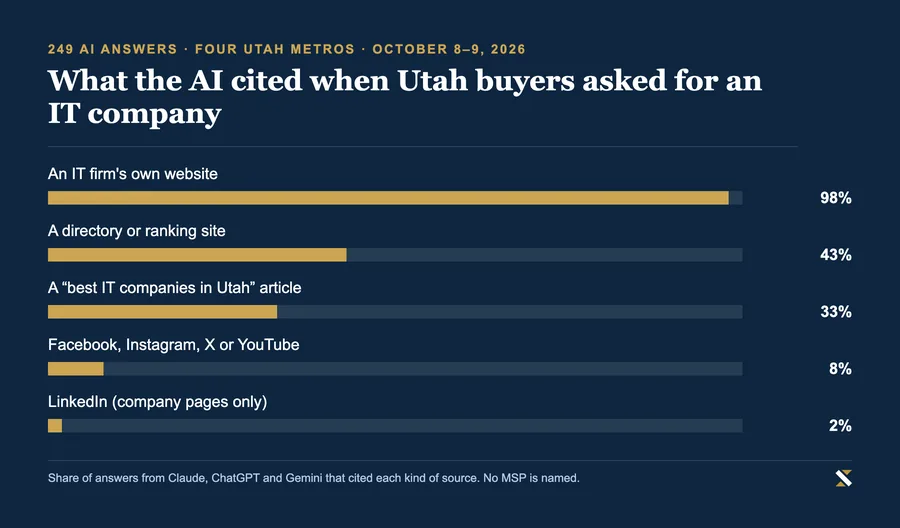
What the AI actually read
On 8 and 9 October 2026 we asked Claude, ChatGPT and Gemini the questions a Utah business owner asks when they need IT help: who are the best managed IT providers near me, who can help with Microsoft 365, who helps with HIPAA or PCI compliance, who offers co-managed IT, and six more. We asked each one several times across four Utah metros and kept 249 answers, each with the list of web pages the AI cited as its sources.2
This is what those sources were:
- 244 of the 249 answers (98%) cited at least one IT firm's own website. ChatGPT and Gemini did it in every single answer.
- 107 (43%) cited a directory or ranking site, such as Clutch, The Manifest, Cloudtango, DesignRush, Yelp or the BBB.
- 82 (33%) cited a "best IT companies in Utah" article published by someone else.
- 20 (8%) cited Facebook, Instagram, X or YouTube.
- 5 (2%) cited LinkedIn. All seven LinkedIn links in those five answers were company pages, used to show that a firm exists. Not one was a post or an article.
The engines also differ more than I expected. ChatGPT cited a directory in only 5 of its 80 answers and leaned almost entirely on the firms' own websites. Claude and Gemini each cited a directory in more than half of theirs.
Why the guide and our data don't disagree
LinkedIn's figure is about professional questions in general: how to run a pricing review, what a good sales process looks like, which CRM to pick. For those, an expert's article is the natural answer, and LinkedIn is full of them. "Which IT company should I hire in Ogden" is a different kind of question. The AI is looking for local businesses, so it goes to where local businesses describe themselves: their websites, then the directories and ranking pages that list them.
The rest of the guide is sound, and most of it is SEO by another name. It tells you to answer the buyer's question at the top of the page, use the words customers actually type, keep the same name and terms everywhere, keep content fresh, and get other credible sites to say the same thing about you. That is the job a well-built MSP website and a set of accurate directory listings already do. MIT Sloan Management Review put it in one line this month: "Without SEO, there is nothing for AI to find."3
What to do this week
- Make your website the clearest source on you. A page for each service and each city you cover, with the answer to the buyer's question in the first few lines, and your company name, address and phone exactly as they appear on Google. Every engine read MSP websites in nearly every answer, so this is the work that reaches all of them.
- Claim and correct your directory listings. Of the 33 Utah MSPs in our index, 14 are listed on at least three of the six referral and review sites we check, and 8 have a Clutch profile. Claude and Gemini cite these sites in more than half their answers. In the case MIT Sloan traced, outdated directory and review listings were a main reason ChatGPT described the company wrongly.
- Keep your LinkedIn company page complete and consistent. The same name, website and city as everywhere else. When an AI did use LinkedIn, the company page is what it used, to confirm you exist.
- Post on LinkedIn for people, not for the AI. Posts and articles are a good way to reach owners, partners and future hires, and they can help when someone asks a "how do I" question. Just don't expect them to get you named when a buyer asks an AI who to hire in your town.
If you want to work through the rest of your setup yourself, the 2026 MSP Search Checklist covers the website, the directories and the AI checks in order.
Want to see which sources the AI uses for you?
The free snapshot checks whether AI assistants name you when a buyer asks, along with your reviews and your website setup, and it usually arrives by email within the hour.
- LinkedIn, "Unlocking AI Search Visibility: The B2B Marketer's Guide to LinkedIn", October 2026. The most-cited-domain figure is LinkedIn's, citing Profound, 2026.
- MSP Search Equity, AI answers collected October 8–9, 2026 for the Utah MSP Search Equity Index: 249 answers from Claude, ChatGPT and Gemini to ten buyer questions across Salt Lake, Utah County, Davis/Weber and St. George, counting each kind of source once per answer. One collection window, so treat the shares as a strong indication rather than a fixed figure. Directory listings from the same index's 33 scorecards. No MSP is named.
- Richter, Lvovich, Van Osch and Richter, "The New Rules of Brand Visibility in AI Search", MIT Sloan Management Review, October 13, 2026.