
If you opened Ahrefs, Semrush or any other backlink checker this week and saw a few thousand new sites linking to you, you are not alone, and nobody is attacking you. I saw it first in our own data and then on my own personal website.
What I saw
On October 27, 2026 I counted the sites linking to the 33 Utah MSPs in our Utah index. Twenty-six of them showed between roughly 2,400 and 3,200 linking domains, which is more than most local businesses earn in ten years. When I looked at what those links were, almost all of them came from sites named like a traffic checker or an SEO tool, on cheap web addresses ending in .shop, .store, .site, .website, .online and .space, and almost all of them had appeared between October 24 and 27, at about 80 to 100 new sites a day.1
It isn't aimed at MSPs. The same thing showed up on my personal site, which has nothing to do with IT, and on random domains that happen to sit next to an MSP in the alphabet. Our agency's own site, registered in early October, has almost none, which tells me the network built its list of domains before then.
What the pages are
Every link sits on a page with the same address on every one of those sites, and every link uses the same wording: "Premium SEO Backlinks" followed by your domain name and "High quality backlinks and link-building services". The page calls itself a directory, and the one I opened was page 27,816 of an alphabetical list with about a thousand domains on each page. That is not a list someone made about you. It is close to a list of every domain on the internet.
The sites I looked up were all registered through the same registrar between September 21 and October 11, 2026, and they all point to the same pair of name servers, so they look like one operator running thousands of throwaway addresses.2
The part that matters: Google isn't meant to see them
When I opened one of these pages in a normal browser, I got a sales page for link-building software. When the same page was requested the way an SEO tool's crawler asks for it, it returned the list of a thousand domains with your name in it. When it was requested the way Google's crawler asks, it said the page didn't exist.
Showing search engines something different from what people see has a name, cloaking, and Google lists it as spam: "presenting different content to users and search engines".3 Here it is used the other way round. The links are built to show up in the SEO tools you and your marketing person look at, while staying out of Google's sight.
I can't tell you for certain why someone would bother. My guess is that a sudden wall of "toxic backlinks" in your SEO dashboard is meant to make you worry, search for help, and land on someone selling link building or link clean-up. Treat that as my reading, not a fact.
What to do about it
Nothing, in Google. Google has said since its December 2022 link spam update that its SpamBrain system is there to "neutralize the impact of unnatural links on search results".4 Its own help page on the disavow tool says to use it only when you have a considerable number of spammy links and they have caused, or are likely to cause, a manual action, and adds that "most sites will not need to use this tool".5 Thousands of links from a network that hides itself from Google is about as far from a manual action as it gets.
Three things are worth doing:
- Don't pay anyone to remove them. If someone emails you about "toxic links" this month, this is probably what they are looking at.
- Don't judge your links by the raw count in your SEO tool. Filter out the spam (most tools show a spam or toxicity score) and look at who is left: directories, your chamber, your vendors, local press. That shorter list is the one that tells you something.
- If your tool sends alerts for new links, expect noise for a few weeks and read past it.
The network has a free removal form, by the way. I didn't use it, and you don't need to either.
How we count links now
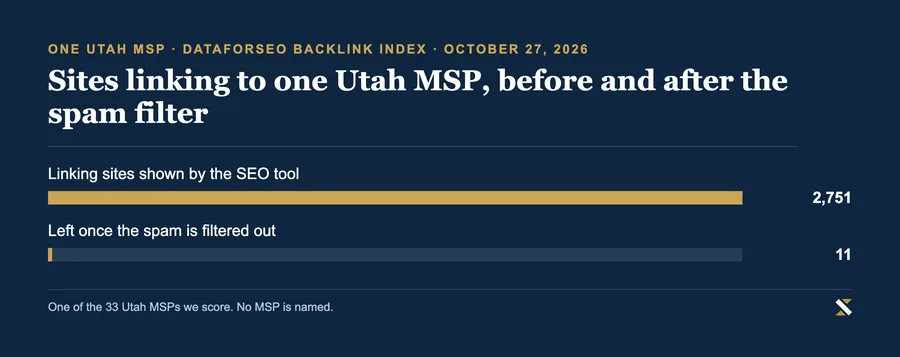
When we check an MSP's links, we leave out anything with a high spam score before we count, and we only name the kinds of sites we recognise: directories, chambers and associations, vendor partner listings and local press. For one Utah MSP, that took the count from 2,751 linking sites to 11. Eleven is the real number, and it's the one we compare with the other MSPs in the state. If you want to check the rest of your setup yourself, the 2026 MSP Search Checklist has a section on links.
Want to know which links actually count for you?
The free snapshot checks your reviews, what AI assistants say about you and your website setup, and it usually arrives by email within the hour.
- MSP Search Equity check of the 33 scored local Utah MSPs in the Utah MSP Search Equity Index, October 27, 2026, using DataForSEO's backlink index: linking domains counted with and without spam, and the newest linking pages for a sample site read with their first-seen dates. No MSP is named.
- Public registry records (RDAP) for ten of the linking domains, read October 27, 2026, and the linking pages themselves, opened the same day.
- Google Search Central, "Spam policies for Google web search", read October 27, 2026.
- Google Search Central Blog, "December 2022 link spam update releasing for Google Search", December 14, 2022.
- Google Search Console Help, "Disavow links to your site", read October 27, 2026.